Tesla Resale Value: OTA, Autopilot & FSD Explained
Tesla Tech Features That Retain Resale Value
Tesla vehicles hold their resale value much better than most cars, thanks to features like over-the-air (OTA) updates, Autopilot, and Full Self-Driving (FSD). These technologies keep older models relevant by improving functionality over time. However, not all features impact resale value equally. Here's a quick breakdown:
- OTA Updates: Keep older Teslas updated with new features, boosting appeal in the used market.
- Autopilot: Standard on all Teslas, but newer hardware versions (like HW3 or HW4) retain more value.
- FSD: Adds limited resale value despite its high upfront cost, especially now that Tesla offers a $99/month subscription.
When buying or selling a Tesla, check the hardware version and battery health to ensure long-term usability. For used Teslas, dealerships like Premium Autos Inc in Norco and El Monte, CA, offer inspected vehicles ready to support Tesla's latest software. While Tesla's tech keeps cars appealing over time, buyers should weigh upfront costs against actual resale benefits.
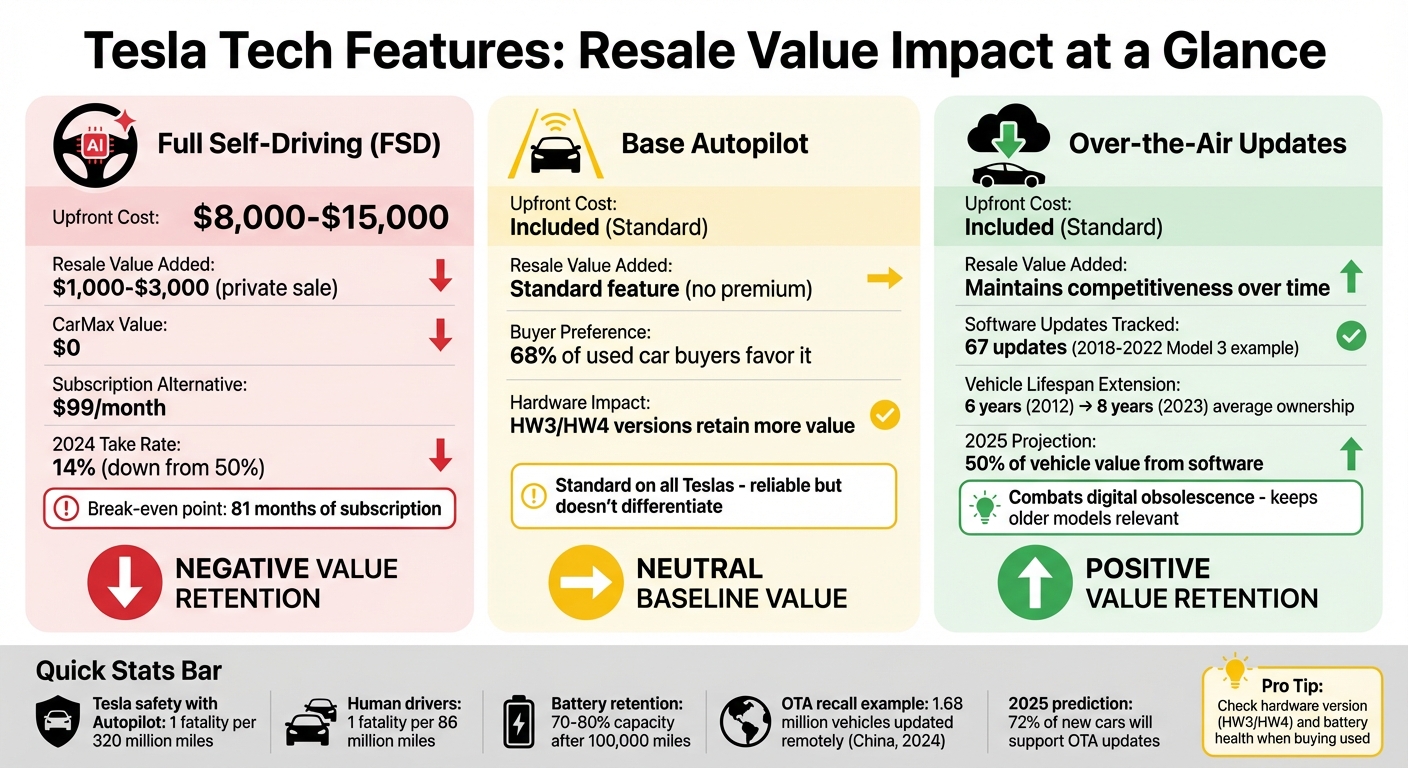
Tesla Tech Features Resale Value Comparison: FSD vs Autopilot vs OTA Updates
1. Autopilot and Driver Assistance Systems
Resale Value Impact
Tesla's Autopilot doesn't significantly boost resale value. For instance, third-party retailers like CarMax assign no extra value to Autopilot features during trade-ins. Their valuation systems simply don't account for software add-ons. Even Tesla itself values Full Self-Driving (FSD) capabilities at just $3,900, despite their retail price of $15,000.
The real impact on resale value lies in the hardware. Cars equipped with newer hardware generations, such as updated camera systems and infotainment computers like HW3 or HW4, tend to retain better value. These components ensure compatibility with future software updates. If you're considering a used Tesla, it's worth checking which hardware generation it has. Older hardware might not support the latest driver assistance features, which could limit the car's long-term functionality.
Feature Longevity
One of Tesla's standout advantages is its ability to extend the lifespan of Autopilot features through over-the-air (OTA) updates. For example, in January 2024, Tesla remotely addressed issues for 1.68 million vehicles in China through a virtual recall. Thanks to these updates, a Tesla from 2020 can receive the same safety improvements and new features as a 2025 model, keeping older cars up-to-date.
The hardware itself is designed for durability. Tesla vehicles rely on eight cameras and ultrasonic sensors, supported by an EV architecture with fewer moving parts. Moreover, Tesla's battery technology retains 70–80% capacity even after 100,000 miles, ensuring the systems powering driver assistance features remain reliable over time. This blend of long-lasting hardware and evolving software enhances Tesla's appeal in the market.
Market Demand
Demand for Autopilot-equipped Teslas remains strong, driven by both technical reliability and consumer confidence in the system. Tesla's safety statistics play a big role here. The company reports one fatality every 320 million miles driven with Autopilot, compared to one every 86 million miles for human drivers. This safety record makes Teslas particularly attractive to families and long-distance commuters who prioritize reduced fatigue and enhanced safety on highways. Such demand keeps these vehicles appealing in the used car market.
sbb-itb-66f4901
2. Full Self-Driving (FSD) Beta
Resale Value Impact
The resale value of Tesla's Full Self-Driving (FSD) feature often falls short of its hefty upfront cost. Although FSD initially costs between $8,000 and $15,000, it typically adds only $1,000 to $1,500 to a car's resale value. Some third-party dealers, like CarMax, assign zero additional value to FSD because their systems don’t account for software upgrades at all.
Selling privately, however, offers a slightly better chance to recover some of the investment. In direct sales, the FSD feature transfers with the vehicle, and buyers may be willing to pay a premium of $1,500 to $3,000 for it. But with Tesla now offering a $99/month subscription for FSD, the resale premium for the upfront purchase has dropped further. Many buyers prefer subscribing to the service rather than paying thousands of dollars upfront. These factors highlight the limited financial return on FSD when selling your Tesla.
Feature Longevity
The value of FSD as a long-term asset has also been reduced due to Tesla’s shift to a subscription-based model. As of February 14, 2026, Tesla no longer sells FSD as a one-time purchase, instead offering it exclusively for $99/month. This change emphasizes FSD as a service rather than a permanent feature tied to the vehicle.
For context, an owner would need to keep their Tesla for nearly seven years to break even on an $8,000 upfront purchase compared to subscribing monthly.
"By moving to a subscription-only model, Tesla is admitting that FSD is a service, not an asset attached to the car."
- Fred Lambert, Editor in Chief, Electrek
Another factor to consider is hardware compatibility. Tesla’s newer hardware, like HW4, ensures access to future FSD updates, while older versions, such as HW3, may not support the latest features. Buyers of used Teslas should check the hardware version to ensure they’ll benefit from ongoing FSD improvements.
Market Demand
The demand for FSD has been declining. By 2024, the take rate for FSD dropped from 50% to just 14%, reflecting growing skepticism among buyers. Despite Elon Musk’s bold claims that FSD would turn Teslas into "appreciating assets", the market has shown otherwise.
Competition is also playing a role. Rivian, for example, introduced its Autonomy+ system at just $50/month, undercutting Tesla’s subscription price. For those considering a used Tesla, especially at dealerships like Premium Autos Inc in Norco and El Monte, CA, it’s important to verify that FSD is still active on the software screen. Some Teslas that pass through Tesla’s inventory may have FSD deactivated.
3. Over-the-Air (OTA) Updates
Resale Value Impact
Tesla's over-the-air (OTA) updates give older models a competitive edge in the used car market. Unlike traditional vehicles that remain static after purchase, Teslas evolve through wireless software updates. This ability to improve over time enhances their appeal and sets them apart from other used vehicles.
These updates also reduce the need for service center visits, cutting down on maintenance costs and lowering overall ownership expenses. This combination of continuous upgrades and reduced costs not only maintains resale value but also ensures the vehicle remains functional and desirable.
"Because the technology of EVs changes at a rapid pace, obsolescence also plays a role in their dramatic depreciation as well as consumer range anxiety." - Phong Ly, CEO, iSeeCars
Feature Longevity
OTA updates are a powerful tool in combating digital obsolescence, effectively extending the lifespan of Tesla vehicles. For example, Tesla owner David Roper tracked 67 individual software updates for his 2018 Model 3 Long Range between May 2018 and January 2022. These updates ranged from small bug fixes to major feature additions, keeping the car relevant and functional years after its initial purchase.
This doesn't just benefit individual owners. The average vehicle ownership period in the U.S. has grown from 6 years in 2012 to 8 years in 2023, a trend partly attributed to OTA updates that extend a car's practical life. For buyers at dealerships like Premium Autos Inc in Norco and El Monte, CA, the promise of ongoing software and safety updates makes Teslas especially appealing. This extended relevance builds trust and confidence in the market.
Market Demand
The ability to stay technologically current is becoming a key factor in vehicle demand. By 2025, experts predict that 50% of a vehicle's value will stem from its software and the user experience it provides. This explains why 72% of all new cars sold by 2025 are expected to support OTA updates - a trend that Tesla initiated back in 2012.
"Today, the longevity of a car is not contingent on style, but rather, digital capabilities." - Cian O'Cuinneagain, Chief Product Officer, Cubic Telecom
Tesla's service revenue, which includes income from software updates, exceeded $2.4 billion in 2020. This underscores the value buyers place on these continuous improvements. OTA updates bring a smartphone-like experience to car ownership, ensuring that Teslas remain relevant and up-to-date over time.
What Your Tesla Will Cost Later and What Will Its Resale Value Be
Pros and Cons
When examining Tesla's tech features, it's clear they come with both benefits and drawbacks that can influence resale value.
Base Autopilot is a standard feature in every Tesla and a strong selling point, favored by 68% of used car buyers. Since it’s included at no extra cost, it eliminates worries about obsolescence. However, because every Tesla comes with it, it doesn’t make your car stand out in a competitive market. On the other hand, opting for advanced features brings a different set of considerations.
Take Full Self-Driving (FSD), for example. While it offers enhanced capabilities, it comes with its own challenges. Priced at $8,000 for new buyers, it typically adds only $1,500 to $3,000 to a car's resale value. With just a 14% take rate in 2024, demand for this feature remains limited. Another issue is hardware compatibility - newer models now come with HW4, which can make older HW3-equipped cars less appealing.
"If you want FSD you should buy a used car with it for a fraction of the price."
- Alec Pow, Economic & Pricing Investigator
The $99 monthly subscription option for FSD further complicates its resale value. Buyers can now try the feature without committing to the higher price of a used car that already has it installed. To match the $8,000 outright purchase cost, a buyer would need to subscribe for 81 months - almost 7 years. For dealerships like Premium Autos Inc in Norco and El Monte, CA, this subscription model gives buyers the chance to test the feature without a long-term financial commitment.
A middle-ground option is Enhanced Autopilot, which adds an estimated $500 to $1,200 to resale value. However, its discontinuation in 2024 means it won’t receive future software updates. This limits its appeal, particularly in rural areas where affordability and range are often more important than advanced driving features.
Conclusion
Tesla's standout features - like over-the-air updates, Autopilot, and advanced battery technology - help its vehicles retain resale value far better than traditional cars. The Model 3, for example, holds a much higher resale value compared to the average vehicle. This is largely because Tesla's software updates keep older models up-to-date, avoiding the rapid digital obsolescence that often plagues other electric vehicles. This tech-forward approach makes buying a Tesla not just about the present but also a smart long-term investment, especially when focusing on factors like battery health and hardware compatibility.
When buying a Tesla, though, it's important to pay attention to some key details. Battery health is a big factor - minimal degradation and solid warranty coverage play a major role in maintaining resale value. Advanced driver assistance features, such as Full Self-Driving, also rely on current hardware. Vehicles with outdated components may not support new features, which can lead to faster depreciation.
On top of its tech advantages, Tesla's low long-term ownership costs make it even more appealing. With savings on fuel (equivalent to $1–$1.50 per gallon) and minimal maintenance, a used Tesla Model 3 can be cheaper to own over 5–7 years than a $25,000 gas-powered car. For those in the market for pre-owned Teslas, Premium Autos Inc in Norco and El Monte, CA, offers a selection of vehicles that undergo thorough inspections. Their expertise in electric vehicles ensures buyers can confidently invest in a Tesla that holds its value through innovative technology and efficiency.
FAQs
How can I check my Tesla’s Autopilot hardware version (HW3 vs HW4)?
To figure out your Tesla’s Autopilot hardware version, you have a couple of options:
- Check the 'Additional Information' screen: Go to the software tab on your vehicle's interface. This screen will display your hardware details.
- Look for visual differences: HW4 models have red optical lenses and higher-resolution cameras, while HW3 models come with black lenses.
Pick whichever method works best for your setup and preferences.
Does FSD subscription status transfer when buying a used Tesla?
No, the FSD subscription does not automatically transfer when you buy a used Tesla. However, Tesla has a one-time FSD transfer program that lets you move the subscription from your current vehicle to a new one. Be aware that the original vehicle will permanently lose FSD as part of this transfer.
What battery health numbers should I look for before buying used?
Look for a battery health, or State of Health (SoH), of around 80% or higher. A lower SoH can seriously impact both the vehicle's range and resale value. For instance, a SoH of 75% might lead to a 30–40% reduction in range and could knock off as much as $6,000 in value. Choosing a vehicle with strong battery health ensures better performance and helps maintain its value over time.