
Premium Autos blog
Tesla vs Mercedes EQE: Which EV Fits You?
By Premium Autos · · 7 min read
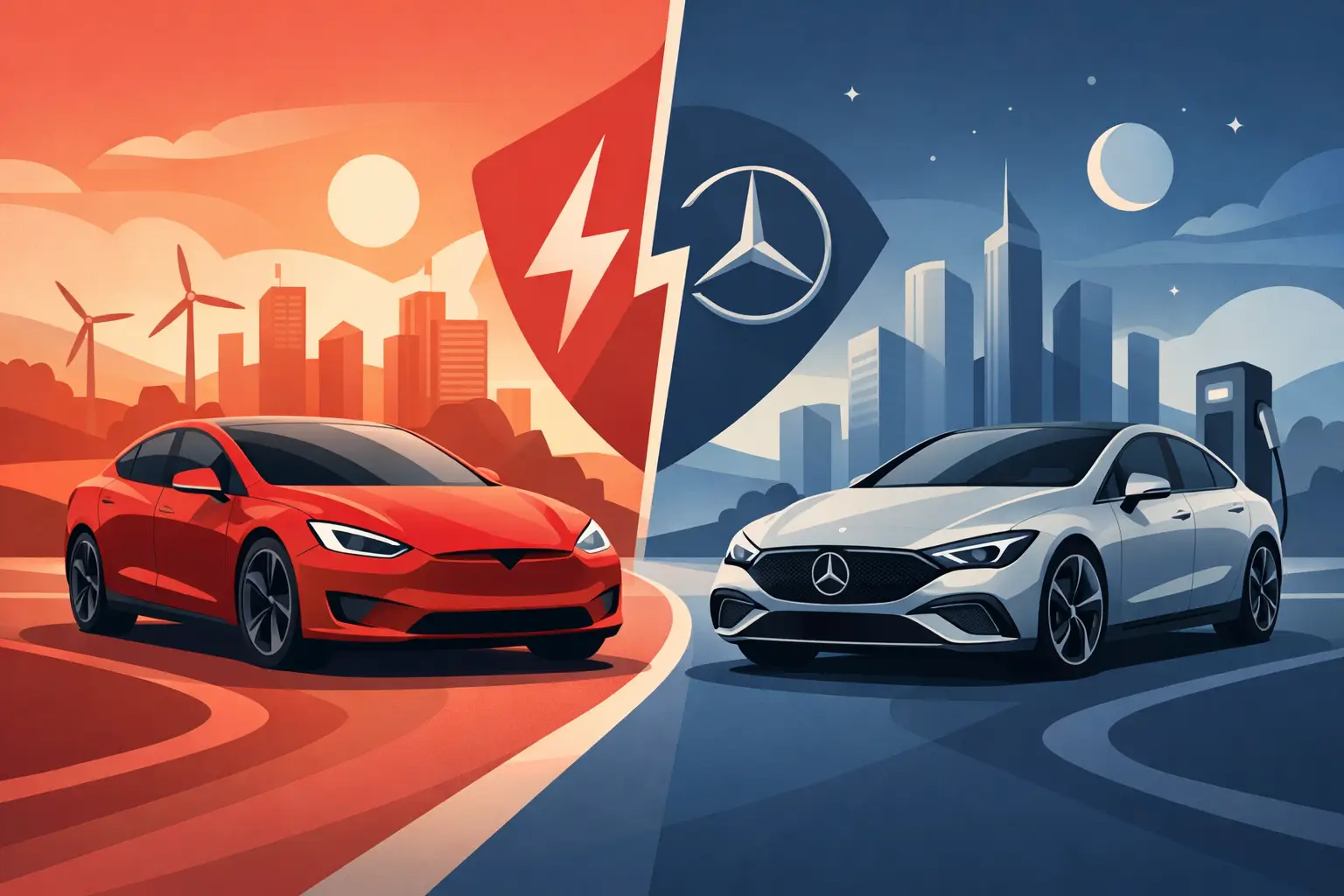
A Tesla can make an hour-long Southern California commute feel cheaper and easier. A Mercedes-Benz EQE can make that same commute feel noticeably quieter, more insulated, and more upscale. That is the real question behind Tesla vs Mercedes EQE: are you shopping for the strongest overall EV value and charging experience, or do you want luxury-first comfort with electric power?
It is not a perfectly one-to-one comparison. Tesla is a brand with several models, while the EQE is a Mercedes-Benz nameplate available as a sedan and SUV. Still, shoppers often cross-shop a Tesla Model 3 or Model Y against an EQE because all can serve as premium daily drivers with modern tech, strong acceleration, and zero tailpipe emissions.
For used EV buyers, the answer usually comes down to purchase price, daily driving habits, charging access, and what you expect from the cabin. Here is how to make the choice with confidence.
Tesla vs Mercedes EQE: The Big Difference
Tesla builds its vehicles around EV efficiency, software, and a charging ecosystem that is hard to ignore. The cabins are clean and minimalist, controls are largely screen-based, and the ownership experience feels technology-led. A Tesla can be a practical choice for commuters, families, and drivers who take regular road trips.
The Mercedes EQE takes a different route. It is designed as an electric luxury car first, with more traditional premium-car priorities: richer materials, stronger sound isolation, a smoother ride, and a more conventional control layout. It feels like a modern Mercedes that happens to be electric, not a tech product on wheels.
Neither approach is automatically better. A buyer who wants a spacious, efficient used Model Y at a competitive price may find the EQE difficult to justify. A buyer who has spent years in luxury sedans and wants a serene cabin may see the EQE as the more natural step into EV ownership.
Price and Used-Car Value
Price matters more than badge value when you are comparing pre-owned EVs. Teslas have been produced in far greater numbers than the EQE, so used shoppers usually have more choices across model years, colors, mileage ranges, and price points. That larger supply can make it easier to find a clean-title Tesla that fits your budget without settling for features you do not want.
The Model 3 is often the entry point for buyers looking for an efficient commuter EV. The Model Y brings more cargo room and a higher seating position, which can better suit growing families or drivers who need room for strollers, groceries, sports gear, or weekend trips. Model S and Model X buyers get more performance or space, although they typically come with higher ownership costs.
A used EQE can be compelling when depreciation has brought its price closer to Tesla territory. It may offer a substantial amount of luxury equipment for the money, especially if it was well-equipped when new. But shoppers should compare more than the selling price. Check insurance quotes, tire costs, warranty coverage, vehicle history, and the availability of nearby service before making a decision.
A lower-priced luxury EV is not always the lower-cost EV to own. On the other hand, an EQE with the right history, condition, and price can be a smart way to access a level of comfort that a similarly priced Tesla may not match.
Range and Daily Efficiency
Tesla has long set the benchmark for real-world EV efficiency. Exact range depends on model year, battery configuration, wheels, weather, speed, and driving habits, but Tesla models generally deliver strong miles per kilowatt-hour. That efficiency matters when you commute from the Inland Empire to Los Angeles, drive across Orange County, or rely on public charging during a busy week.
The EQE sedan has competitive EPA range in certain configurations, and it is a capable long-distance EV. The EQE SUV typically gives up some range for its taller body and added utility. In either case, Mercedes gives buyers enough range for most daily Southern California driving, particularly if charging at home is part of the plan.
Do not buy based on the largest range number alone. Consider your actual routine. If your round-trip commute is 50 miles and you charge overnight, both Tesla and EQE models can be more than adequate. If you frequently drive to Las Vegas, Northern California, or Arizona, charging speed and route planning become just as important as rated range.
Charging Is Tesla's Major Advantage
For many drivers, Tesla's charging network remains the clearest reason to choose a Tesla. Superchargers are widespread, easy to locate through the vehicle, and integrated into Tesla's navigation system. The car can plan charging stops, estimate battery percentage on arrival, and reduce the mental work of long-distance EV travel.
Mercedes EQE models use the CCS charging standard, and newer access options may expand where some Mercedes drivers can charge. Even so, the overall experience can be less straightforward depending on the model year, account setup, adapter requirements, and station compatibility. Public charging outside the Tesla network also varies widely in reliability and payment process.
That does not make the EQE a poor choice. If you charge at home most nights and only take occasional road trips, you may barely notice the difference. But if fast charging is a regular part of your routine, Tesla's ecosystem deserves serious weight in your decision.
Cabin Comfort, Ride, and Technology
This is where the Mercedes often pulls ahead. The EQE feels more traditionally luxurious. Expect a quieter cabin, more detailed interior finishing, and a ride tuned for comfort. It is especially appealing for buyers who spend significant time in traffic or want their EV to feel like a genuine upgrade from a luxury gas sedan or SUV.
Tesla cabins are intentionally simple. The center screen handles most functions, physical buttons are limited, and the design can feel open and futuristic. Some shoppers love the clean layout and responsive software. Others prefer Mercedes' more familiar controls, available driver displays, and higher-end cabin atmosphere.
Tesla generally wins on software personality. Features, interface updates, route planning, and app integration are central to the ownership experience. Mercedes offers advanced technology as well, but its appeal is less about novelty and more about refined execution.
Before you decide, sit in both. Check rear-seat room, cargo access, visibility, seat comfort, and how easily you can adjust climate or navigation while driving. A screen layout that looks impressive online may not suit your habits in real traffic.
Performance and Driving Feel
Both brands can deliver quick acceleration. Even base EV models often feel much faster from a stop than comparable gas-powered vehicles. Tesla's instant response and low center of gravity give it a playful, direct feel, especially in performance-oriented versions.
The EQE is usually less interested in feeling aggressive. It is composed, stable, and smooth, with power delivered in a more polished way. Drivers who want sharp response may lean Tesla. Drivers who want a calm, confident highway cruiser may prefer Mercedes.
If you are considering the EQE SUV against a Model Y, pay attention to how each handles broken pavement, freeway expansion joints, and parking-lot maneuvering. The Model Y's practicality is hard to beat, while the EQE SUV can feel more premium from behind the wheel.
What to Check Before Buying Either Used EV
A used EV should be evaluated like any other vehicle, but a few details deserve extra attention. Review the vehicle history report and confirm it has a clean title. Ask about accident history, prior repairs, tire condition, charging equipment, and remaining factory warranty coverage. Verify that charging ports, cameras, screens, power seats, climate control, and driver-assist features operate as expected.
Battery health matters, but do not assume an older EV is automatically a weak EV. Look at current displayed range, service history when available, and how the vehicle performs on a thorough test drive. Also verify whether the vehicle includes applicable charging adapters, since replacing missing equipment can add expense.
For buyers with a trade-in or financing questions, get the numbers early. A realistic trade value and a soft-pull prequalification can help you compare payment options without wasting time on vehicles outside your target budget.
Which One Should You Buy?
Choose a Tesla if you want the strongest mix of used-market selection, charging convenience, efficiency, practical space, and technology. For many first-time EV buyers, especially those commuting across Southern California, a clean-title Model 3 or Model Y is the easier ownership decision.
Choose a Mercedes EQE if comfort, luxury design, and a quieter driving experience matter more than having the simplest possible road-trip charging setup. It can be an excellent fit for drivers who charge at home, value a premium cabin, and find the right pre-owned example at a competitive price.
The best EV is the one that fits your real life, not the one with the most impressive spec sheet. Test-drive both, compare the complete ownership cost, and focus on a clean-title vehicle with the condition, range, and payment that make sense for your next several years of driving.
Browse used Teslas for sale at our Norco and South El Monte stores.



