
Premium Autos blog
Preowned Tesla Battery Warranty Guide
By Premium Autos · · 7 min read
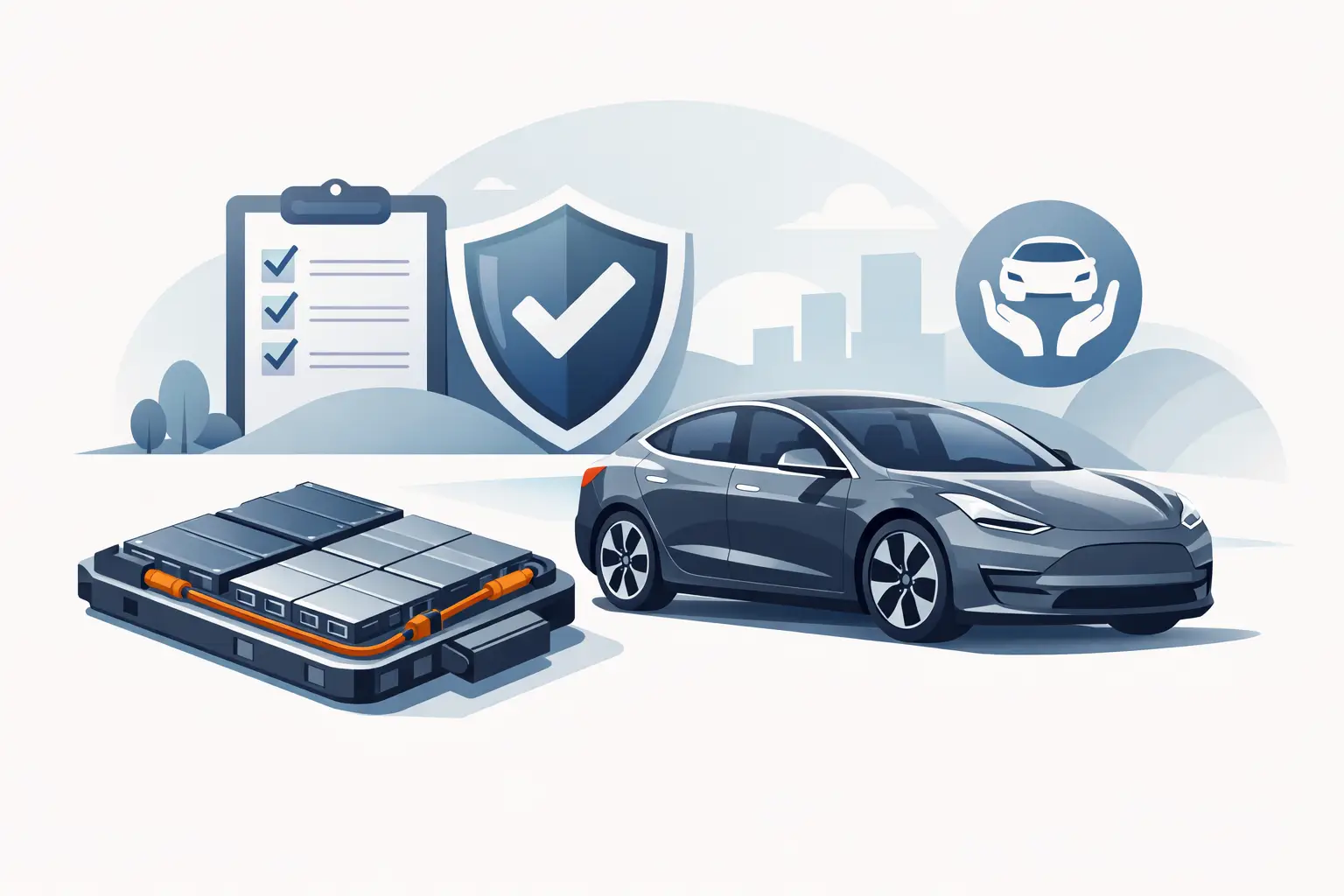
Battery warranty questions usually show up right after the price looks good. That makes sense. If you're shopping used, this preowned Tesla battery warranty guide is one of the fastest ways to separate a smart deal from a stressful one.
A Tesla can be a great value on the used market, but battery coverage is where buyers need real clarity. Range, age, mileage, trim, and model year all affect what protection may still be left. If you're comparing a Model 3 in El Monte, a Model Y in Norco, or a higher-mileage Model S anywhere in Southern California, knowing the battery warranty details helps you buy with more confidence and a lot less guesswork.
Why battery warranty matters more on a used Tesla
On a gas vehicle, buyers usually focus on engine and transmission risk. On a Tesla, the battery and drive unit are the headline components. They are central to performance, charging behavior, and long-term ownership cost.
That does not mean used Teslas are risky by default. It means the battery warranty deserves a closer look than shoppers may be used to giving a typical used car. A low monthly payment can lose its shine quickly if you never verified what coverage remains, whether the vehicle still meets your daily range needs, or whether battery degradation is within a normal window.
The good news is that Tesla's battery and drive unit warranties are generally separate from the basic limited vehicle warranty. For used buyers, that distinction matters. A car may be out of its original bumper-to-bumper style coverage while still retaining battery and drive unit protection.
Preowned Tesla battery warranty guide: what is usually covered
Tesla battery warranties typically cover defects in materials or workmanship for the battery and drive unit during the applicable warranty term. They also usually include a minimum battery capacity retention level for many models, commonly stated as 70% during the warranty period.
That sounds simple, but shoppers should not treat it like unlimited coverage for any drop in range. Real-world range changes with weather, wheel size, driving speed, charging habits, elevation, software behavior, and battery age. A used Tesla showing less range than its original EPA number is not automatically a warranty claim.
What matters is whether the battery has an eligible defect or falls below the stated retention threshold while still inside the warranty term. That's why used buyers should focus less on advertised range from years ago and more on the actual remaining coverage tied to that specific vehicle.
How Tesla battery warranty terms vary by model
This is where details matter. Tesla has used different battery warranty terms depending on model and configuration.
Many used Model 3 Rear-Wheel Drive vehicles have different battery coverage than Long Range or Performance trims. Model Y variants can also differ depending on year and configuration. Older Model S and Model X vehicles may have a different warranty structure than newer ones.
In plain English, two Teslas sitting side by side can have very different battery warranty timelines even if they look similar in photos. One may still have years of battery protection left. The other may be close to expiration because of age, mileage, or both.
That is why a serious shopper should ask for the in-service date, current mileage, exact trim, and model year before assuming coverage. A clean title and attractive price are strong starting points, but battery warranty status can change the real value of the car.
Age vs mileage - whichever comes first
Tesla battery warranties generally run for a set number of years or miles, whichever comes first. That phrase is easy to skip past, but it is a big deal on used inventory.
A commuter car with high miles may have less battery warranty remaining than a weekend-driven Tesla of the same year. On the other hand, an older low-mileage vehicle can still be limited by time. Buyers who only look at mileage or only look at model year miss half the picture.
Battery degradation is normal
Every EV battery degrades over time. Some loss is expected. Most shoppers should not panic over normal degradation on a used Tesla, especially if the vehicle still comfortably fits their commute, charging routine, and weekend driving needs.
The smarter question is not, "Has it lost any range?" The smarter question is, "Does the current range and remaining warranty still make sense for how I drive?"
Does the battery warranty transfer to the next owner?
In many cases, Tesla's battery and drive unit warranty stays with the vehicle and transfers to subsequent owners for the remaining term. That is one reason used Teslas remain so appealing.
Still, buyers should verify the specific vehicle rather than relying on broad assumptions. Warranty transfer rules can be affected by title status, prior history, or exclusions tied to damage or other factors. If a vehicle has a clean title and documented history, that usually makes the conversation much more straightforward.
This is one reason many buyers prefer shopping with an established dealer that understands Tesla inventory instead of trying to decode a private-party listing with missing details. A cheaper price is not always the better value if key warranty and history questions are left unanswered.
What is not the same as battery warranty
A lot of used EV confusion starts here. Battery warranty is not the same as full-vehicle coverage, and it is not a blanket promise that every battery-related complaint will be fixed.
For example, cosmetic wear, trim issues, suspension wear, tires, and many general used-car items are separate from battery and drive unit coverage. Range reduction caused by normal aging may also be treated differently from an actual battery defect.
Shoppers should also understand that a used Tesla may no longer have its original limited vehicle warranty even if the battery warranty remains active. That does not make it a bad buy. It just changes how you evaluate the deal. Price, condition, service history, and remaining battery coverage all need to work together.
What to check before buying a used Tesla
A practical preowned Tesla battery warranty guide should help you shop better, not just learn terms. Before you commit, confirm the exact model, trim, model year, current mileage, and in-service date if available. Then verify what warranty remains on the battery and drive unit.
Next, look at real-world usefulness. Ask yourself whether the current displayed range works for your actual life. A buyer with a short daily commute and home charging may be perfectly happy with a used Tesla that has modest degradation. A buyer who drives long freeway miles across Southern California every day may want more margin.
Condition matters too. Review title status, accident history, and overall vehicle condition. Battery warranty is valuable, but it should not distract from the rest of the vehicle. A clean-title used Tesla with transparent history, strong cosmetic condition, and remaining battery coverage is usually a much easier yes than a mystery car with a tempting price tag.
Ask better questions during the shopping process
A smart buyer does not just ask, "Does it have warranty?" Ask how much time and mileage remain. Ask whether the vehicle is a standard range, long range, performance, or plaid configuration if applicable. Ask whether the current range estimate has been checked recently. Ask for clarity on title history and whether there are any known charging or battery-related concerns.
Those questions do not make you difficult. They make you prepared.
When a used Tesla with less warranty can still be a good buy
Not every strong deal needs a long runway of battery coverage. Sometimes a lower-priced used Tesla with less remaining warranty still makes excellent sense, especially if the battery condition is normal, the title is clean, and the vehicle fits a shorter commute or second-car role.
This is where budget matters. Some shoppers want the maximum remaining factory coverage and are willing to pay more for it. Others want the most affordable path into Tesla ownership and are comfortable with a shorter coverage window in exchange for lower upfront cost. Neither approach is wrong.
The key is buying with eyes open. If the discount is meaningful, the condition is right, and the vehicle still fits your needs, a higher-mileage Tesla can still be a smart move. If the price is not aggressive enough to offset reduced warranty, keep shopping.
Why clean-title used Teslas stand out
For battery warranty peace of mind, clean-title inventory usually gives buyers a clearer path. It makes ownership history easier to evaluate, simplifies financing conversations, and reduces the chance of unpleasant surprises after the sale.
That is one reason many Southern California buyers look for specialists that know used Teslas inside and out. At Premium Autos Inc, the focus on clean-title Tesla inventory helps buyers cut through confusion faster and shop with more confidence.
A used Tesla should feel exciting, but it should also feel explainable. If the warranty status, mileage, title, and battery expectations are not clear, pause the deal. There are too many good options on the market to force a maybe.
The right used Tesla is not just about getting into the brand for less. It is about buying a vehicle that matches your budget, your commute, and your comfort level with the remaining battery warranty. When those pieces line up, the deal feels right before you ever hit the accelerator.
Browse used Teslas for sale at our Norco and South El Monte stores.



