Best Coolant Types for Tesla and Hybrids
Best Coolant Types for Tesla and Hybrids
Electric and hybrid vehicles require specialized coolants to maintain battery health, manage heat, and prevent damage to high-voltage components. Using the wrong coolant can lead to costly repairs, including battery replacements exceeding $10,000. Here’s a quick breakdown of the top coolant options for Tesla and hybrid vehicles:
- Tesla G48 Coolant: An ethylene glycol-based formula with low electrical conductivity, excellent corrosion protection, and high thermal efficiency. Approved for Tesla models, it offers a lifespan of up to 150,000 miles or 5 years.
- Dober EV Coolant SLC: Known for ultra-low conductivity (<100 µS/cm) and strong corrosion protection, this coolant is designed for long-term use in high-voltage systems.
- Propylene Glycol-Based Coolants: Safer and less toxic than ethylene glycol, these coolants are ideal for vehicles like the original Tesla Roadster but have moderate thermal efficiency.
- Hybrid OAT (HOAT) Coolants: A mix of organic and inorganic additives, offering robust corrosion protection for mixed-metal systems and compatibility with various EV brands.
Quick Comparison
| Coolant Type | Electrical Conductivity | Corrosion Protection | Thermal Efficiency | Service Life | Notes |
|---|---|---|---|---|---|
| Tesla G48 | <50–60 µS/cm | High | High | Up to 150,000 miles | OEM-approved for Tesla vehicles |
| Dober EV SLC | <100 µS/cm | High | High | Long-life | Ultra-low conductivity |
| Propylene Glycol | <80 µS/cm | Moderate | Moderate | Up to 200,000 miles | Non-toxic, safer for humans/animals |
| Hybrid OAT (HOAT) | <100 µS/cm | High | High | 60,000–150,000 miles | Suited for mixed-metal systems |
Always check your vehicle's manual for the recommended coolant type, as mixing incompatible coolants can cause severe damage. For Tesla models, ensure you use the correct coolant (e.g., G48 for most models, HTF-LS for newer variants) to avoid voiding your warranty.
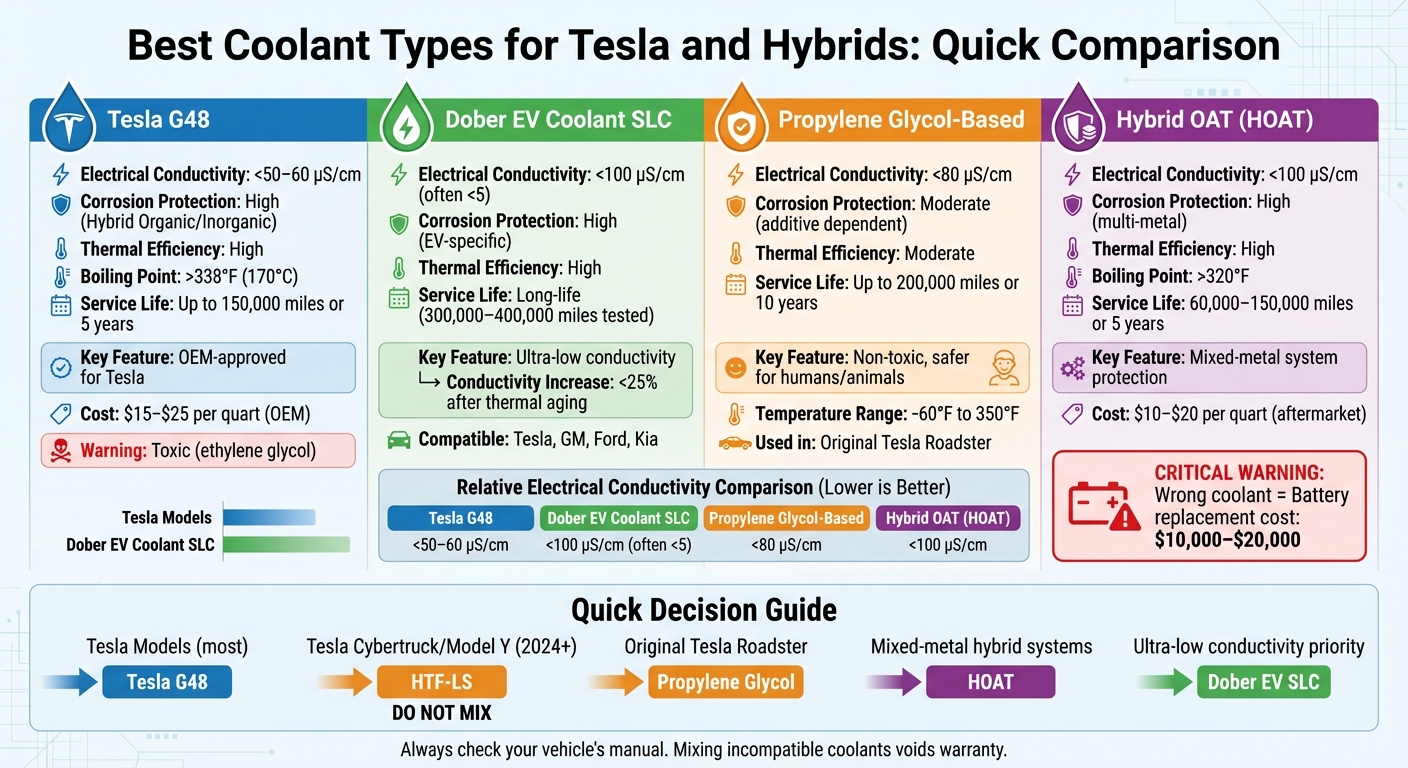
EV Coolant Types Comparison Chart: Conductivity, Protection & Service Life
EV coolant specifications
sbb-itb-66f4901
1. Tesla G48 Coolant
Tesla G48 is an ethylene glycol-based coolant specially formulated with low-silicate, low pH, and phosphate-free technology. Originally developed for high-performance European vehicles, Tesla adopted it for its ability to deliver both thermal stability and compatibility with EV components. It comes as a pre-mixed 50/50 solution with deionized water, so there's no need for dilution. This makes it particularly suited for protecting the sensitive systems in electric vehicles (EVs).
Electrical Conductivity
One standout feature of G48 is its ability to maintain an electrical resistivity above 15,000 Ω·cm - far surpassing the roughly 2,000 Ω·cm of standard green antifreeze. This high resistivity is crucial for EVs, as it reduces the risk of electrical shorts if the coolant leaks near high-voltage components. Dr. Tom Corrigan, Director of EV Technology at Prestone, highlights this importance:
"Lower fluid electrical conductivity means a lower risk of electrical shorting, less heat generation, and a lower probability of fire in the off chance the fluid contacts the HV components".
To achieve this, G48 relies on non-ionizing additives, which help prevent ionic interference and ensure safety in high-voltage environments.
Corrosion Protection
G48 uses Hybrid Organic Acid Technology (HOAT) to protect aluminum-heavy EV cooling systems. Unlike older coolants that contain high levels of silicates and phosphates, G48 prevents metallic ions from entering the coolant. This is critical because such ions can increase electrical conductivity and pose safety risks. Tesla specifies maintaining at least a 50% ethylene glycol concentration to retain these anti-corrosion properties. However, using more than 60% can reduce the coolant's ability to transfer heat effectively.
Thermal Efficiency
The thermal performance of G48 is another key advantage. Its boiling point exceeds 338°F (170°C), significantly higher than the 266°F (130°C) of traditional antifreeze. Tesla's service manual supports this, stating:
"G-48 meets all Tesla thermal performance specifications".
Additionally, the coolant includes a defoamer system to eliminate air bubbles, which could otherwise disrupt heat transfer.
Service Life
Being an OAT-based coolant, G48 offers an extended lifespan - up to 5 years or 150,000 miles. However, Tesla's recommended service intervals vary by model, ranging from 4 to 8 years. Tesla even suggests that the coolant could last the entire lifetime of the vehicle. For those looking at costs, aftermarket options like Zerex G48 are available for about $24.69 per gallon (50/50 mix), while Tesla's OEM coolant is priced between $15 and $25 per quart.
2. Dober EV Coolant SLC
When it comes to Tesla and hybrid vehicles, choosing a coolant that meets high safety and performance standards is critical. Dober EV Coolant SLC is a pre-mixed, ethylene glycol–based solution specifically designed for battery electric vehicles (BEVs) and hybrids. Delivered as a 50/50 blend with water, it’s compatible with Tesla, GM, Ford, and Kia models. Its ultra-low conductivity enhances safety in high-voltage environments.
Electrical Conductivity
Traditional internal combustion engine coolants typically measure conductivity levels between 3,000 and 5,000 µS/cm. In contrast, Dober EV SLC maintains conductivity under 100 µS/cm, aligning with the strict requirements of EV systems. Even in thermal aging tests simulating 300,000 to 400,000 miles, the coolant showed a conductivity increase of less than 25%. For comparison, a leading competitor experienced a 450% rise under similar conditions. As Dober explains:
"Lower-conductivity coolant makes the possibility of an electrical fire in the vehicle less likely".
In addition to its low conductivity, this coolant provides excellent corrosion protection for EV components.
Corrosion Protection
The formula includes specialized inhibitors that protect metals commonly used in EV cooling systems, such as stainless steel (304L and 316L) and aluminum alloys (5052, 6061, and 7075). By maintaining a low ionic concentration, it minimizes metal leaching, which can lead to corrosion currents. ASTM D1384 testing demonstrated strong protection for aluminum alloys, showing minimal weight loss and reduced discoloration. Even at high temperatures of 150°C (302°F), the coolant remains stable, keeping pH levels and conductivity in check.
Thermal Efficiency
Thermal performance is another standout feature of Dober EV SLC. With a higher heat capacity than air-cooled systems, it ensures efficient energy storage and heat transfer. Designed for indirect liquid cooling, the coolant keeps battery temperatures within a narrow 5°C range, helping to prevent cell degradation. By reducing corrosion and scale buildup on metal surfaces, it also maintains thermal transfer efficiency over time.
Service Life
Extensive testing in Parr reactors at 150°C confirmed the coolant’s thermal stability, equivalent to 300,000 to 400,000 miles of real-world use. Even under these extreme conditions, the fluid maintained stable pH levels and ionic concentration. To preserve its effectiveness, avoid exceeding ethylene glycol concentrations of 60%, as higher levels can reduce cooling performance.
3. Propylene Glycol-Based EV Coolants
Propylene glycol (PG)-based coolants provide a safer alternative to traditional ethylene glycol solutions like Tesla G48 and Dober EV. Their standout feature is reduced toxicity, making them particularly suitable for electric and hybrid vehicles in scenarios where safety is paramount. For instance, the Tesla Roadster utilizes a 50/50 mix of water and Sierra Antifreeze Coolant-PG, differing from newer Tesla models that rely on ethylene glycol formulations. The lower toxicity of PG coolants minimizes risks to both humans and animals in case of leaks.
Electrical Conductivity
PG-based coolants are designed with organic acid technology to maintain ultra-low conductivity, which is critical in high-voltage environments. This low-conductivity formulation helps prevent short circuits near lithium-ion batteries. Most battery electric vehicles (BEVs) require conductivity levels below 50 µS/cm, while fuel-cell stacks demand even lower thresholds, typically under 5 µS/cm. Additionally, non-ionic inhibitors are used to protect against corrosion without raising conductivity, unlike traditional internal combustion engine (ICE) coolants, which can have conductivity levels between 2,000 and 5,000 µS/cm. This combination of low conductivity and reduced toxicity sets PG coolants apart from ethylene glycol options.
Corrosion Protection
PG coolants utilize Organic Acid Technology (OAT) to safeguard metal components like aluminum, copper, and brass. They avoid ionic compounds that could elevate conductivity, ensuring compatibility with high-voltage systems. A 50% glycol mix is the minimum required to maintain corrosion inhibitors, though exceeding 60% can reduce thermal efficiency. These coolants are also tested for compatibility with materials such as EPDM rubber, nylon tubing, and modern aluminum alloys. By promoting even cell temperatures and preventing hotspots, PG-based coolants enhance battery cycle life and lower the risk of thermal runaway. Many owners of these advanced vehicles share their maintenance experiences in customer reviews of specialized EV service providers.
Thermal Efficiency
While PG is more viscous than water, it still offers far better heat transfer properties than air. Most systems use a 30% to 50% PG mixture to strike a balance between freeze protection and efficient heat transfer. Some designs compensate for PG's higher viscosity by increasing heat exchanger surface areas by approximately 30%. These coolants can function effectively across a wide temperature range, from –60°F to 350°F.
Service Life
PG coolants combine their thermal properties and low toxicity to support extended service intervals, often lasting up to 10 years or 200,000 miles. This aligns well with the long lifespans of other EV-specific formulas. The lower operating pressures and temperatures typical of electric vehicles help minimize oxidation and contamination, contributing to these extended intervals. Routine testing of glycol concentration and pH ensures corrosion inhibitors remain active and the fluid retains its effectiveness.
4. Hybrid OAT (HOAT) Coolants
HOAT coolants bring together the benefits of organic acid technology (OAT) and inorganic additives like silicates or phosphates, creating a formula that offers both quick-acting and long-lasting corrosion protection. This combination makes them particularly suited for the complex cooling systems found in modern electric and hybrid vehicles. For instance, Tesla endorses G48 coolant, a nitrate-free HOAT formula, for use in vehicles across Europe, the Middle East, and Africa (EMEA) regions. The dual-action mix of fast-acting inorganic components and stable organic acids helps prevent rust and scale buildup effectively.
Corrosion Protection
HOAT coolants are especially effective at protecting aluminum components, which are widely used in electric vehicle (EV) and hybrid cooling systems due to their lightweight nature. Ken Lavacot, a Certified Master Automobile Technician, highlights the risks of neglecting coolant maintenance:
"If the cooling system service is neglected the coolant will turn acidic and start eating away at the very components it was designed to protect such as gaskets and aluminum engine parts".
By combining quick inorganic inhibitors with durable organic acids, HOAT coolants prevent the formation of acids that can damage mixed-metal systems. This corrosion protection is critical not only for longevity but also for maintaining the integrity of high-voltage components.
Electrical Conductivity
HOAT coolants formulated for electric vehicles are designed to maintain low electrical conductivity, with resistivity levels around 10,500 Ω·cm. This helps reduce the risk of short circuits in high-voltage systems. In contrast, traditional internal combustion engine coolants often have much higher conductivity, which can pose safety risks in electrified vehicles. A proper mixture - typically 50%–60% ethylene glycol - is essential to balance corrosion protection and cooling performance.
Thermal Efficiency
Managing heat is another key role of HOAT coolants. These coolants are engineered for high thermal performance, which is critical for dissipating heat from battery packs, motors, and power electronics. Many high-performance HOAT formulas for EVs have boiling points exceeding 320°F, preventing issues like vapor lock during fast charging. However, it’s important to use the correct subtype for your vehicle. For example, Tesla, BMW, and Volvo recommend phosphate-free HOAT (turquoise), while Toyota, Honda, and Nissan require phosphated HOAT (pink or blue).
Service Life
HOAT coolants are designed to last, offering service intervals of up to 5 years or 150,000 miles. The relatively lower operating temperatures and pressures in electric vehicles further extend their lifespan by reducing oxidation. Pricing varies, with aftermarket HOAT coolants costing between $10 and $20 per quart, while OEM options range from $15 to $25 per quart.
Pros and Cons
Here’s a summary of the strengths and drawbacks of each coolant type, based on their unique properties and applications.
Tesla G48: This coolant is OEM-approved for Tesla and Rivian vehicles, ensuring compatibility and reliable performance. It uses hybrid organic/inorganic corrosion inhibitors to protect various metals and plastics in EV drive systems. However, the ethylene glycol base is toxic, and its compatibility is limited to specific vehicles. Tesla also warns that using non-approved coolants can void the warranty.
Dober EV Coolant SLC: Known for its ultra-low conductivity, this coolant minimizes the risk of electrical fires in high-voltage systems. It performs reliably even under extreme thermal aging. The downside? Its availability is more restricted compared to mainstream alternatives.
Propylene glycol-based coolants: These are non-toxic and environmentally safer, with a food-grade quality that makes them less harmful to animals. However, as Jamie Turner, Product Manager at Ecofreez Coolants, explains:
"Ethylene glycol is more cost effective and has better heat transfer, along with a somewhat higher boiling point than propylene glycol".
While propylene glycol is safer, it offers moderate thermal efficiency and is not typically approved for Tesla systems.
HOAT coolants: These provide rapid protection for mixed-metal systems by combining fast-acting inorganic inhibitors with stable organic acids. They are versatile across different vehicle brands, but their service intervals are generally shorter than those of pure OAT formulations. Pricing varies widely: Tesla OEM coolant costs $15–$25 per quart, premium aftermarket options range from $10–$20 per quart, and budget coolants under $10 per quart often fail to meet EV standards.
| Coolant Type | Electrical Conductivity | Corrosion Protection | Thermal Efficiency | Service Life |
|---|---|---|---|---|
| Tesla G48 | <50–60 µS/cm | High (Hybrid Organic/Inorganic) | High | Up to 150,000 miles |
| Dober EV SLC | <100 µS/cm (often <5) | High (EV-specific package) | High | Long-life |
| Propylene Glycol | <80 µS/cm | Moderate (Additive dependent) | Moderate | Variable |
| Hybrid OAT (HOAT) | <100 µS/cm | High (Multi-metal protection) | High | 60,000–150,000 miles |
Conclusion
Tesla vehicles generally require either G-48 coolant (blue) or, for newer models like the Cybertruck and certain Model Y variants produced at Giga Texas after October 2024, HTF-LS coolant (orange). The original Tesla Roadster, however, uses a propylene glycol-based Sierra Antifreeze mixed at 50%. It's crucial to check the coolant color before adding more - blue indicates G-48, while orange signals HTF-LS. Mixing the two is a big no-no; it turns the fluid brown, complicating diagnostics, and could void your warranty if unapproved coolants are used.
This level of care applies to hybrid systems too. Many hybrid vehicles require specific coolants tailored to their unique systems. For mixed-metal setups, HOAT coolants are often recommended due to their compatibility. Always reference your owner's manual for the exact part number and specifications, as these can vary depending on the model year and manufacturing location.
Maintaining the correct coolant is essential, especially for protecting the battery - a component that can cost anywhere from $10,000 to $20,000 to replace. At Premium Autos Inc, every pre-owned Tesla and hybrid vehicle undergoes a thorough inspection to ensure the cooling system meets OEM standards. They also provide Carfax or AutoCheck reports to confirm the service history. Their inventory includes clean-title Tesla models like the Model 3, Model S, Model X, and Model Y, with prices starting at under $25,000.
FAQs
How do I tell if my Tesla needs G48 (blue) or HTF-LS (orange) coolant?
To determine whether your Tesla needs G48 (blue) or HTF-LS (orange) coolant, check the service documentation or labels on your vehicle. Generally, G48 is found in earlier models or specific regions, while HTF-LS is more common in newer models or different areas. Always refer to the manufacturer's specifications to ensure you're using the correct coolant for your Tesla. Using the wrong type could impact your vehicle's performance or longevity.
Can I top off EV coolant with water or a “universal” coolant?
No, you shouldn’t use water or a general-purpose coolant to top off the coolant in an EV. Always stick to the specific coolant recommended by the vehicle’s manufacturer. For example, Tesla specifies using G-48 ethylene-glycol coolant. If you need to mix it, combine it with distilled water in a 50/50 ratio to ensure proper performance.
What symptoms suggest my EV or hybrid coolant needs service or testing?
Visible leaks, like puddles forming under your car, are a clear sign that your EV or hybrid coolant might need attention. You might also encounter warning messages on your dashboard, such as “Maintenance required for hybrid battery cooling parts.” Other red flags include reduced cooling efficiency, overheating, or a drop in overall performance. It's crucial to tackle these problems quickly to avoid causing additional damage.